
Contents
Overview
The concept of "Sub-Saharan Africa" emerged primarily as a descriptor to differentiate the continent's southern regions from North Africa, which shares closer historical and cultural ties with the Middle East and the Mediterranean world. Historically, the Sahara Desert acted as a significant barrier, influencing distinct patterns of migration, trade, and cultural development. Ancient civilizations like the Kingdom of Kush and the Aksumite Empire flourished in regions now considered part of Sub-Saharan Africa, predating widespread Arab influence. The trans-Saharan trade routes, established by groups like the Berbers, facilitated the exchange of goods and ideas, but also contributed to the distinct identities of regions north and south of the desert. European colonial powers reshaped political boundaries in the 19th century, often disregarding pre-existing ethnic and cultural divisions, a legacy that continues to influence the region's geopolitical landscape.
⚙️ Defining the Region
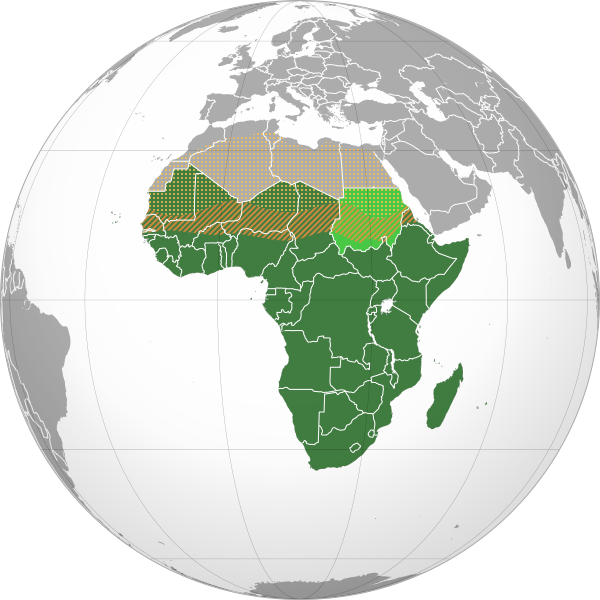
Geographically, Sub-Saharan Africa is defined by its position south of the Sahara Desert. However, the precise number of countries included can vary. The African Union adopts a broader definition, recognizing all 55 African states and grouping them into five distinct regions, which may not perfectly align with the "Sub-Saharan" designation. This definitional fluidity highlights that "Sub-Saharan Africa" is as much a geopolitical and cultural construct as it is a purely geographical one, often used in international development and discourse to address shared challenges and opportunities distinct from North Africa.
📊 Key Facts & Numbers
The region holds vast natural resources, including significant portions of the world's gold, diamonds, and platinum reserves.
👥 Key People & Organizations
Numerous individuals and organizations have shaped the understanding and development of Sub-Saharan Africa. Organizations such as the African Development Bank play a crucial role in financing development projects across the continent, while the World Health Organization (WHO) works on public health initiatives. Academic institutions like the University of Cape Town and the University of Lagos are centers for research and education, contributing to the region's intellectual capital. The African Union serves as the continent's primary political and economic bloc, aiming to foster integration and cooperation.
🌍 Cultural Impact & Influence
The cultural output of Sub-Saharan Africa has had a profound global impact. Music genres like Afrobeat, originating in Nigeria, have influenced artists worldwide. Traditional art forms, from Benin bronzes to Shona sculpture, are celebrated in museums globally. Furthermore, the region's diverse ethnic groups and languages contribute to a rich tapestry of traditions, cuisines, and social structures that continue to fascinate and influence global culture, impacting everything from fashion to culinary trends.
⚡ Current State & Latest Developments
In 2024, Sub-Saharan Africa is experiencing rapid technological adoption, particularly in mobile technology and fintech. Countries like Kenya are leading in mobile money services through platforms like M-Pesa, transforming financial inclusion. The region is also a growing hub for renewable energy, with significant investments in solar and wind power projects, aiming to address energy deficits. Political landscapes remain dynamic, with ongoing efforts towards democratic consolidation in some nations and persistent challenges in others. The African Continental Free Trade Area (AfCFTA) continues its implementation, aiming to boost intra-African trade and economic integration, with significant progress reported in recent years. Digital transformation initiatives are also gaining momentum across various sectors, from agriculture to healthcare.
🤔 Controversies & Debates
The very definition of "Sub-Saharan Africa" can be contentious. Some argue it perpetuates a colonial-era categorization that lumps together vastly different regions and cultures, overlooking unique national and sub-regional identities. The term can sometimes be used in development discourse in ways that homogenize diverse experiences, potentially leading to one-size-fits-all policy approaches. Furthermore, the distinction between Sub-Saharan Africa and North Africa is sometimes blurred by shared historical connections, such as the influence of Arab culture and Islam across vast swathes of the region. Debates also persist regarding the most effective strategies for economic development, with differing views on the role of foreign aid versus internal market-driven growth and the impact of resource extraction on local economies.
🔮 Future Outlook & Predictions
The future of Sub-Saharan Africa is poised for significant demographic and economic shifts. The expansion of the African Continental Free Trade Area (AfCFTA) is expected to significantly boost intra-African trade, potentially creating one of the world's largest single markets. Continued investment in infrastructure, technology, and human capital will be critical. Experts predict that advancements in artificial intelligence and digital technologies will play an increasingly vital role in addressing development challenges, from agriculture to governance, though ensuring equitable access and mitigating digital divides will be paramount.
💡 Practical Applications
Sub-Saharan Africa is a critical region for understanding global trends in demographics, economic development, and cultural innovation. Its vast natural resources are vital for global supply chains, particularly in minerals essential for renewable energy technologies and electronics. The region's burgeoning youth population represents a significant future consumer market and labor force. Furthermore, its rich cultural heritage continues to influence global arts, music, and fashion. In terms of practical applications, the region is a living laboratory for mobile-first solutions in finance, health, and education, offering models that can be adapted globally. The ongoing development of the African Continental Free Trade Area (AfCFTA) is a significant practical application of regional integration efforts with global economic implications.
Key Facts
- Category
- geography
- Type
- topic